Bernstein documentation
Reproducible multi-agent runs. Verifiable results.
Any agent, any deliverable. A deterministic scheduler runs AI agents in parallel, gates what they produce, and records every step, so a run can be checked after the fact, offline, from its artifacts alone.
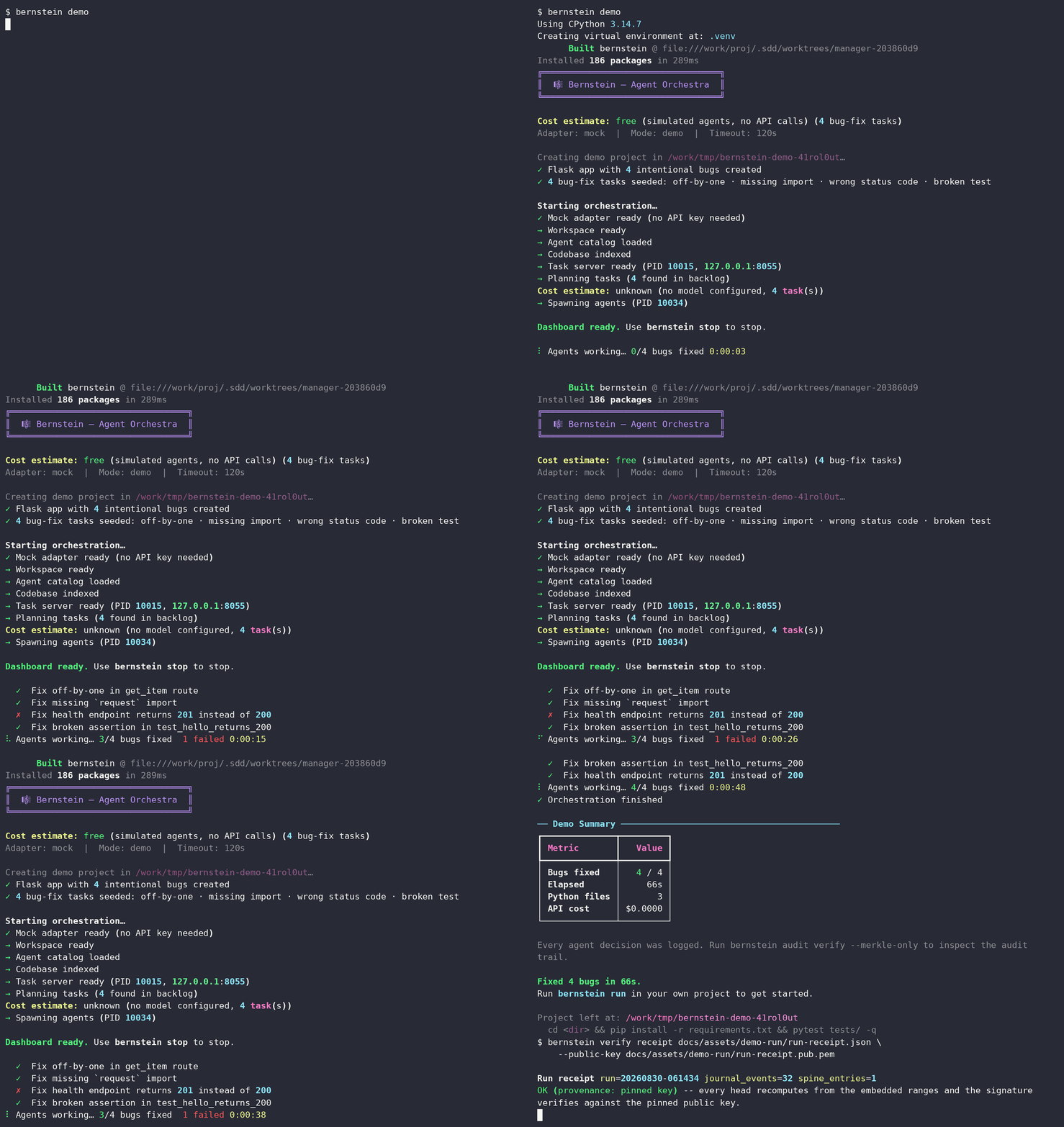
What it does
Bernstein takes a goal, breaks it into tasks, assigns them to AI agents running in parallel, verifies the output, and merges the results. You come back to working code, passing tests, and a clean git history - or, when a task declares an artifact contract, to a signed deliverable: a research dossier, a dataset, an audit evidence pack.
No framework to learn. No vendor lock-in. Agents are interchangeable workers - swap any agent, any model, any provider. The orchestrator itself is deterministic Python code. Zero LLM tokens on scheduling.
Results stay checkable after the run ends: an always-on lineage spine and replay journal record what happened, and an opt-in HMAC-chained audit log (BERNSTEIN_AUDIT=1) adds receipts you can verify offline.
What "offline" means, precisely. bernstein artifact verify and bernstein audit verify --merkle-only need only the on-disk artefacts: the Ed25519 signature on every lineage entry, the parent-hash chain, the re-derived content hash, and the Merkle seal over the daily audit files all check without any secret. Replaying the per-line HMAC chain is different: bernstein audit verify, --hmac-only, audit verify-hmac and audit verify --receipt all need the install's audit key, which by design lives outside the audit volume. To hand a reviewer who does not hold that key something they can still authenticate, export a pack with bernstein audit export --signature-kind hmac-chain+pubkey; it signs the chain head with the lineage Ed25519 key, so the bundle verifies against a public key alone.
Install
Then run:
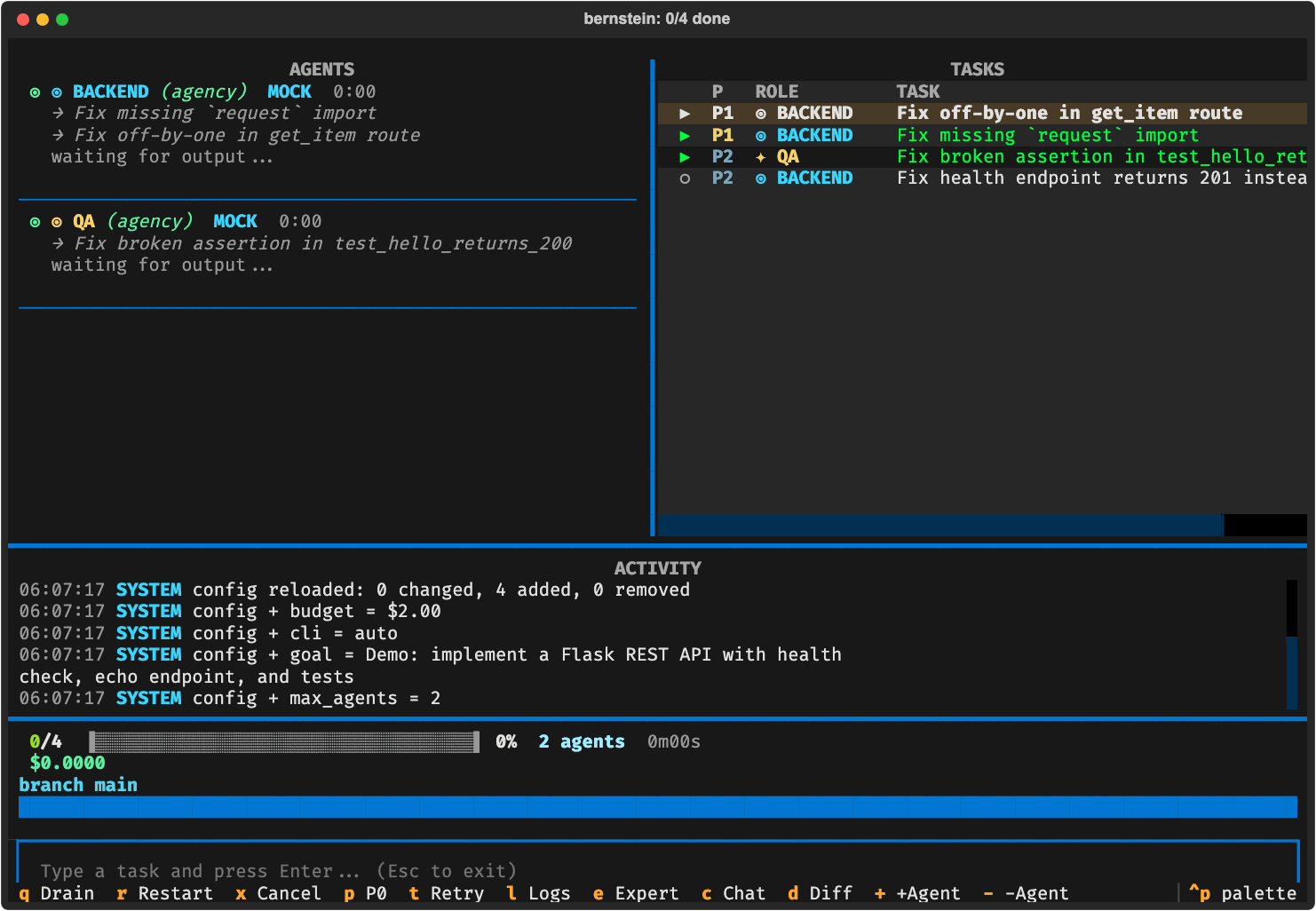
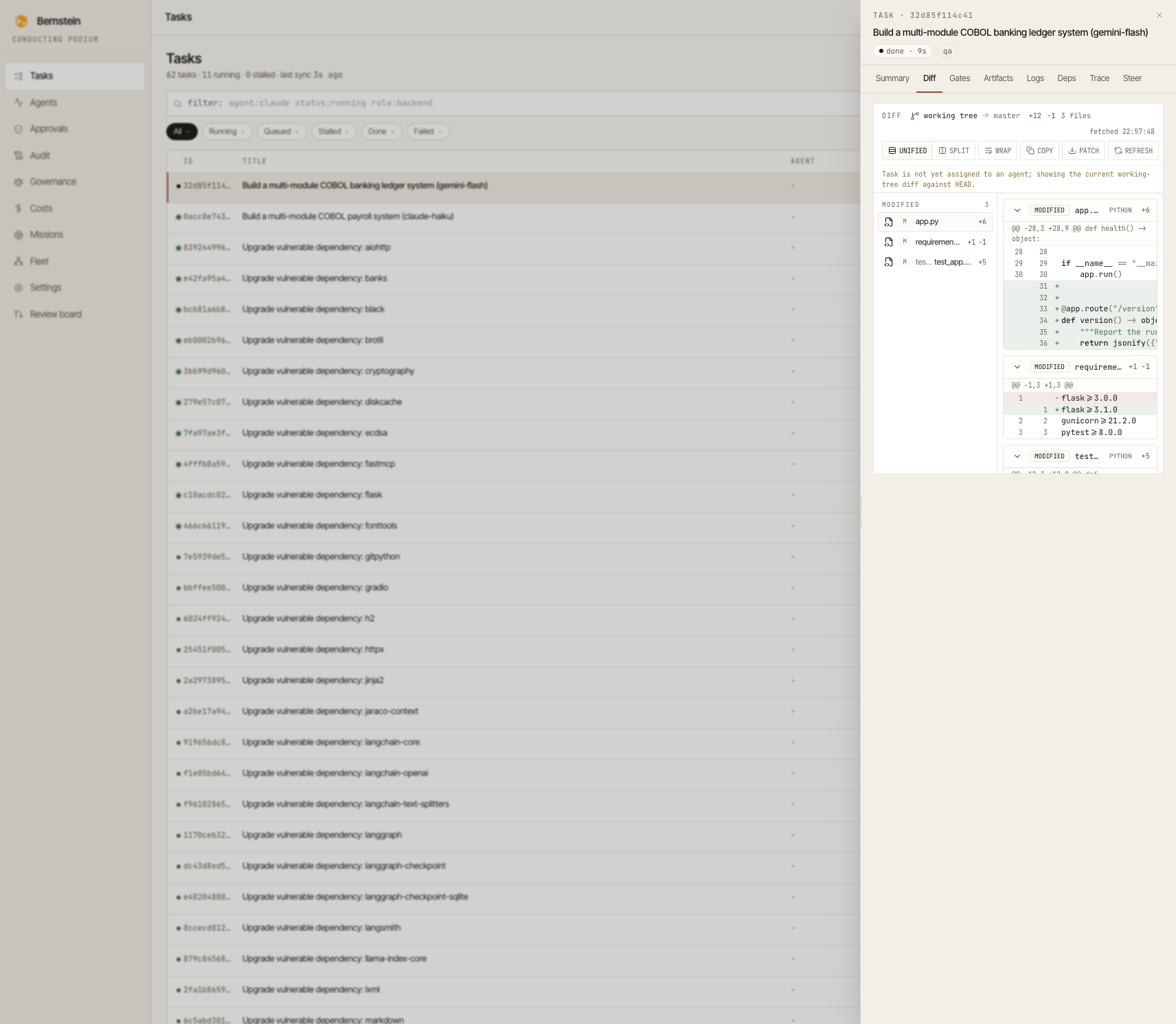
A run in flight is watchable from either operator surface. Both read the same task API, so neither is a lagging mirror of the other.
 |  |
|---|---|
bernstein live — the terminal dashboard | bernstein gui serve — the same run in a browser |
Why Bernstein?
-
Deterministic scheduling
Pure Python orchestration - zero LLM tokens on coordination. Every decision is auditable code, not a model response.
-
Verifiable results
An always-on lineage spine and replay journal record every run. Set
BERNSTEIN_AUDIT=1(or pass--audittobernstein run) for an HMAC-chained audit log and receipts you can verify offline. -
Any agent, any model
40+ CLI adapters: Claude Code, Codex, OpenAI Agents SDK v2, Gemini, Cursor, Aider, GitHub Copilot, Devin Terminal, CLM gateway, AWS Q Developer, and more. Mix cheap local models with cloud models in the same run.
-
Git worktree isolation
Each coding agent works in its own git worktree (artifact-mode tasks get an isolated plain directory). No merge conflicts. Clean history. Parallel by default.
-
Built-in verification
Janitor system checks tests, lint, types, and PII before any agent output lands in your codebase.
Why as a forward-deployed-engineering tool
Bernstein is built for the forward-deployed engineering pattern: parachute onto a client repo and stand up an AI engineering crew in minutes. State lives in .sdd/ - no server to provision. Per-agent credential scoping keeps your keys out of the client's environment. The broad adapter spread means the swarm runs on whichever CLI agent the client already trusts (Claude Code, Codex, Gemini CLI, Aider, and more). Every step is an HMAC-signed audit record, replayable for client compliance review.
Quick links
| Install | Get Bernstein installed and verify it runs |
| First run | Take Bernstein from "installed" to "first orchestrated task complete" |
| Configuration | bernstein.yaml reference |
| Adapter Guide | Supported agents and how to add your own |
| API Reference | Task server REST API |
| Integrations | what Bernstein bridges to, by the name you call it |
| Architecture | How Bernstein works under the hood |
| Lifecycle FSM | Task and agent state machines with transition tables |
| What's New | Pointer to per-release notes under docs/release-notes/ |
| Release notes | One page per tagged version, plus what has landed since the newest tag |
| Air-gap installation | Wheelhouse build, signed verification, --profile airgap, deny-all egress |
| Governance coverage | Which failure class each control prevents, the test that proves it, and what is left uncovered |
Links
Created by Alex Chernysh (@chernistry, @alex_chernysh on X).